Duplicate and Fraudulent Invoices: Catching Them Before They Are Paid
When an operational mistake delays customer billing, the revenue is postponed, but it can usually be collected eventually.
However, when an accounts payable team mistakenly pays a duplicate or fraudulent vendor invoice, that money is genuinely gone.
In mid-to-large enterprises processing thousands of supplier invoices every month, duplicate disbursements and fraudulent billing represent a quiet, persistent cash leak. Suppliers resubmit invoices because they haven't received payment confirmation, changing an invoice date or adding an "A" suffix to bypass basic database checks. Bad actors compromise legitimate vendor email accounts and submit authentic-looking bills with altered bank remittance details. Unscrupulous contractors bill twice for the same equipment hire across two separate project cost centers.
The finance department rarely catches these errors during the payment run. Why? Because finance teams are consistently operating under intense time pressure to clear backlogs before the weekly payment cutoff.
When an accounts payable specialist has three hundred invoices to clear before 4:00 PM on Thursday, thorough manual cross-checks get skipped. A payment voucher is created, the director approves it on their phone, the funds leave the bank account, and the enterprise absorbs the loss.
The Anatomy of Improper Payments
Improper accounts payable disbursements fall into two distinct categories, both driven by weaknesses in human verification workflows:
1. Inadvertent Duplicate Invoices
The vast majority of duplicate payments do not stem from criminal intent; they arise from vendor confusion and fragmented communications:
- A supplier emails an invoice to
accounts@company.com. Four days later, having received no acknowledgement, their account manager forwards the exact same invoice to the company's project engineer. Both versions enter the approval workflow through different entry points. - A vendor issues a pro-forma invoice for an advance deposit, followed weeks later by a final commercial tax invoice that fails to deduct the initial deposit payment.
- A vendor updates an invoice number (changing
INV-8021toINV-8021-Rev) after correcting a minor clerical detail, but the original invoice was already entered into the system.
Because the invoice numbers or dates do not match identically, standard database unique-index constraints fail to trigger a warning.
2. Business Email Compromise and Remittance Fraud
The more financially catastrophic threat is targeted payment fraud.
In this scenario, a fraudster compromises a legitimate vendor's email system or registers a visually deceptive "look-alike" domain. They intercept ongoing commercial discussions and submit a genuine-looking invoice for real services rendered. The document looks completely authentic—correct logo, accurate purchase order number, valid tax registration.
There is only one subtle change: the bank account IBAN, SWIFT code, or remittance address at the bottom of the page has been replaced with an account controlled by the attacker.
If the accounts payable team simply updates the banking details in the ERP based on the visual document without an out-of-band verification protocol, the company wires funds directly into a fraudulent account. Once the payment clears the international banking system, recovery is practically impossible.
Why Manual AP Audits Fail Under Pressure
Most corporate finance policies dictate that accounts payable clerks must verify invoices before entering them into a payment batch. In reality, these manual controls consistently fail due to three operational realities:
1. Volume and Fatigue
A human eye comparing hundreds of eight-digit invoice numbers and twenty-two-character IBAN strings will inevitably experience cognitive fatigue. After reviewing forty invoices in a row, a clerk's brain glosses over subtle discrepancies, such as an "8" swapped for a "B" or a missing digit in a bank code.
2. Disconnected Information Silos
To catch an improper invoice manually, a clerk must cross-reference at least four separate records:
- The incoming PDF invoice
- The historical payment ledger in the ERP (checking for prior payments)
- The approved purchase order (checking remaining deliverables and authorized totals)
- The verified vendor master registry (checking authorized banking coordinates)
When these systems require logging into multiple screens, opening disparate tabs, or hunting through archived email threads, clerks skip the cross-checks to keep work moving.
3. False Urgency and Executive Override
Fraudulent invoices are frequently submitted with aggressive payment terms or accompanied by urgent emails claiming that critical operational deliveries will halt unless payment is wired immediately. Under pressure, staff bypass standard approval controls to avoid being blamed for operational delays.
The Mechanics of Automated Duplicate and Fraud Detection
Preventing improper payments does not require slowing down financial operations. It requires implementing automated duplicate invoice detection and integrity gates that execute mathematical checks on every bill before it can be added to a payment batch.
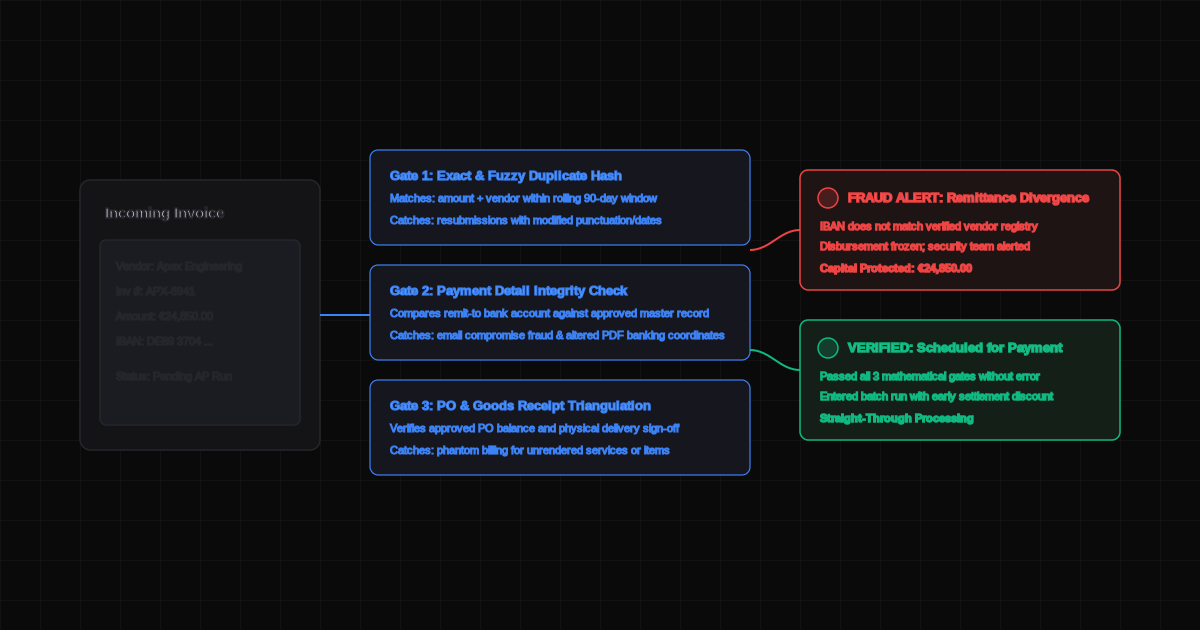
An effective automated defense operates through three programmatic validation gates:
[Incoming Invoice]
        ↓
[Gate 1: Exact & Fuzzy Hash Match] → (Flags duplicate amounts, dates ±10 days)
        ↓
[Gate 2: Remittance Details Integrity] → (Compares IBAN/SWIFT to Master Registry)
        ↓
[Gate 3: 3-Way Order & Receipt Match] → (Triangulates PO balance & Goods Receipt)
        ↓
[Verified for Disbursement] OR [High-Priority Fraud Freeze]
Gate 1: Exact and Fuzzy Duplicate Hashing
Standard accounting systems only check whether an invoice number has already been entered for a specific vendor ID. Sophisticated duplicate detection looks far deeper.
The system computes multi-attribute match scores across historical transaction records:
- Exact Matches: Identical supplier tax ID, invoice number, and currency amount.
- Fuzzy Invoice Number Matches: Detecting when an invoice number matches an existing record after stripping non-alphanumeric characters (e.g., matching
INV/2026/04againstINV-2026-04orINV202604). - Variance Matches: Detecting invoices from the same vendor with the exact same net or gross amount submitted within a rolling sixty-day window, even if the invoice numbers are completely different.
- Cross-Vendor Matches: Catching instances where the exact same invoice document or amount is billed under two different internal subsidiary accounts.
If a match exceeds a defined probability threshold, the invoice is immediately frozen, preventing it from entering any payment queue.
Gate 2: Remittance Banking Detail Verification
This gate provides an absolute defense against Business Email Compromise (BEC) and altered-invoice fraud.
When an invoice is parsed, the system extracts the bank account number, IBAN, and SWIFT/BIC code printed on the face of the document. It immediately compares these coordinates against the company's verified vendor master file.
If the banking details on the incoming document differ in any character from the approved master record:
- The invoice is locked immediately.
- The payment system prevents any bank file or voucher generation.
- An automated security flag is triggered, notifying both internal finance leadership and the verified supplier contact through an out-of-band verification protocol.
Under no circumstances is an accounts payable user permitted to update a vendor's banking details simply because a new number appeared on an incoming invoice.
Gate 3: Three-Way Triangulation (PO, Goods Receipt, Invoice)
For procurement of physical goods and contracted services, the system executes automated three-way matching before an invoice can be scheduled:
- Purchase Order Balance: Does the invoice reference an active, authorized PO, and does the invoiced amount fall within the remaining committed balance?
- Proof of Delivery / Service Sign-Off: Has the warehouse logged a corresponding goods receipt docket, or has the project lead signed off on the milestone deliverable?
- Unit Pricing Consistency: Do the itemized rates match the agreed contractual price schedule, or has the vendor quietly introduced an unannounced price increase?
When an invoice claims payment for items that were never marked as received in the warehouse management system, the system routes the variance back to procurement automatically, stopping payment before cash leaves the business.
The Return on Investment: Capital Preserved
Implementing automated duplicate and fraud detection delivers immediate, measurable financial protection:
- Zero Unrecoverable Cash Leakage: High-risk fraudulent invoices and duplicate submissions are intercepted at the perimeter, before cash disbursements are executed.
- Accelerated Accounts Payable Cycles: Because the system executes mathematical validation in milliseconds, legitimate, verified invoices flow smoothly into scheduled payment runs, qualifying the business for early settlement supplier discounts.
- Elimination of Recovery Overhead: The finance team no longer wastes days attempting to claw back overpayments from uncooperative vendors or filing protracted insurance claims for email fraud losses.
- Audit and Regulatory Peace of Mind: Every invoice approved for payment carries an immutable digital record demonstrating that duplicate checks, bank verification, and PO matching were satisfied.
How Kalvron Protects Corporate Disbursements
At Kalvron, we engineer connected operational systems that safeguard enterprise finance operations.
We do not ask your team to replace your ERP or change your primary commercial banking partners. Instead, we implement an autonomous validation layer that operates directly between your invoice intake, your ERP ledgers, and your banking payment workflows.
Our systems continuously cross-reference incoming documents against your historical ledgers, verify banking integrity against master records, and enforce rigorous multi-way matching rules tailored to your commercial policies across Europe, Singapore, Malaysia, and the Gulf.
Catching an improper invoice before payment takes zero effort when the checks are automated. Trying to recover money after it has left your bank account is almost impossible. Protect your working capital by making automated verification a non-negotiable standard in your accounts payable workflow.
Find out what your business can stop doing by hand.
In 20 minutes, we map your workflow and show you where an AI OS fits. No pitch. Just the diagnosis.
Book a call