What to Judge an AI Business Operating System On: Outcomes, Not Features
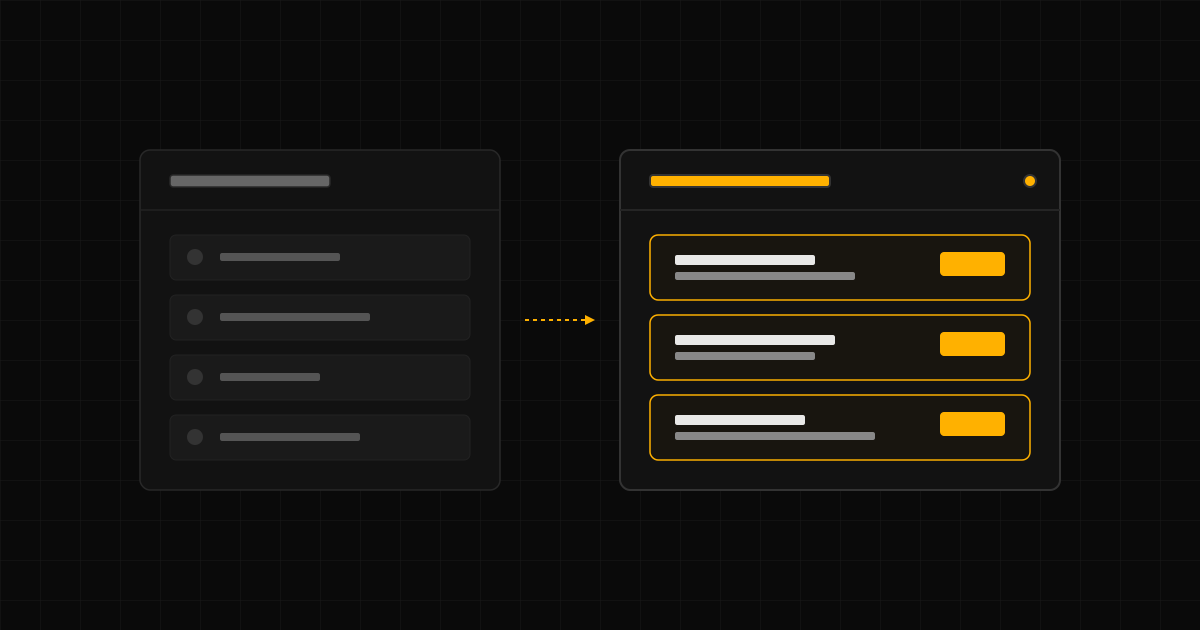
When enterprise leadership begins evaluating autonomous technology, procurement discussions often fall into a familiar software trap. Teams assemble elaborate spreadsheets comparing feature matrices: how many document formats an interface ingests, which language models power the backend, or how slick the executive reporting dashboard looks during a vendor demonstration.
This evaluation model is borrowed from thirty years of buying traditional software licenses. It measures what a tool claims it can do in a staging environment. It does not measure what actually happens to business performance when the software meets messy, legacy company operations.
According to the Salesforce and MuleSoft 2026 connectivity benchmark—an annual study conducted by an enterprise integration vendor—the average organization manages 957 distinct applications, yet only 27% are integrated with one another. Adding another feature-dense platform to an estate that is already 73% disconnected rarely solves operational bottlenecks.
A business does not invest in technology to own more capabilities. It invests to move one of four commercial needles: protect revenue, increase revenue, expand operational capacity, or reduce unit operating costs.
Evaluating an ai business operating system requires shifting scrutiny away from feature checklists and toward verified operational outcomes.
The four outcomes that actually matter
Every business problem in mid-sized and large enterprises resolves into four financial and operational dimensions. When assessing any system or implementation partner, these categories form the true scorecard.
1. Revenue protection: Preventing earned money from evaporating
Before asking how a system finds new growth, leadership must measure how much existing revenue disappears through operational cracks:
- Unbilled scope changes and delayed milestone invoicing.
- Contract renewal notifications missed because account records live in disconnected spreadsheets.
- Customer accounts that churn quietly after repetitive, unresolved delivery delays.
A capable system should be judged on its ability to maintain uninterrupted commercial continuity. If a system cannot demonstrate how it prevents billable work from slipping through departmental handoffs, its advanced natural language capabilities are irrelevant.
2. Revenue acceleration: Compressing commercial cycle times
Time decays commercial intent. When an enterprise buyer requests a customized quote, every day of delay reduces the likelihood of closing the transaction:
- How long does it take for a complex quote to move from sales submission through engineering validation to customer delivery?
- How many deals stall because representatives forget to follow up on outstanding proposals after day five?
The outcome to evaluate is transaction velocity: shortening the elapsed time between customer interest and contract execution.
3. Operational capacity: Growing output without expanding headcount
When order volumes increase by 30%, does the enterprise need to hire 30% more operational coordinators, data clerks, and accounts payable staff?
- Capacity is expanded when existing teams can process double the transaction volume without overtime or burnout.
- The measurement is throughput per team member, not the number of software licenses distributed across the department.
4. Direct unit cost reduction: Lowering the cost of execution
Every business process has a measurable unit cost:
- The fully loaded clerical cost to verify, match, and approve an incoming supplier invoice.
- The staff hours required to onboard a new corporate client or register an employee across internal directories.
If a proposed system does not measurably compress the cost per completed operational transaction, it represents software overhead rather than structural operational leverage.
The evaluation framework: Five questions to ask any provider
Vendor demonstrations are structured to highlight scripted success paths. To understand whether an operating architecture can handle real-world operations, buyers must probe how the system behaves when conditions diverge from the script.
Here are five concrete diagnostic questions that bypass marketing presentations:
1. "How does this system operate when an essential tool has no API?"
Most enterprises rely on at least one legacy application—a proprietary enterprise resource planning system, an older accounting tool, or a regional supplier portal—that lacks modern application programming interfaces.
If the provider's architecture depends entirely on clean, pre-built API connectors, your team will remain trapped doing manual data entry between screens. Ask them to demonstrate how their agents interact directly with user interfaces, virtual desktops, and document streams.
2. "Who is responsible when an exception occurs?"
In software demonstrations, data flows smoothly. In production, 15% to 20% of business transactions contain missing fields, mismatched line items, or conflicting instructions.
Determine the exact failure behavior:
- Does the system halt silently when an anomaly occurs?
- Does it dump cryptic error logs on your internal IT department?
- Or does it isolate the specific variance, gather the surrounding commercial context, and route a plain-language summary to a designated human manager for sign-off?
3. "Where does our proprietary commercial data reside?"
Feeding confidential contracts, customer pricing agreements, and company financials into public artificial intelligence models creates profound regulatory and commercial risk.
Demand precise architectural clarity:
- Are models running in isolated, private environments under your direct control?
- Is customer data utilized to train public foundation models?
- Does the system maintain an immutable, audit-ready log showing every system interaction, keystroke, and visual verification?
4. "What is required of our team after deployment?"
Many self-serve platforms require internal client teams to write prompt logic, maintain brittle integration recipes, and debug workflow failures when software updates occur.
Clarify the operational model:
- Are you purchasing raw software that your staff must learn and maintain?
- Or are you engaging an implementation partner whose team designs, integrates, monitors, and operates the system as a managed service?
5. "What single operational metric will we measure at day sixty?"
Avoid vague commitments regarding "digital transformation" or "enhanced productivity."
Agree on one unambiguous operational metric before signing an agreement: reducing invoice processing cycle time from eleven days to two, eliminating quote turnaround backlogs, or automating three-way purchase order reconciliation up to pre-approved limits. If a provider cannot commit to a clear operational baseline, they are selling software potential rather than business outcomes.
Grounding technology in operational reality
The purpose of autonomous technology is not to showcase computational cleverness. It is to run routine business workflows reliably, quietly, and accurately inside the software applications a company already owns.
This is the standard serious organizations hold their systems to. Moving beyond feature checklists and demanding demonstrable commercial outcomes ensures that your technology investment translates into durable enterprise value.
Find out what your business can stop doing by hand.
In 20 minutes, we map your workflow and show you where an AI OS fits. No pitch. Just the diagnosis.
Book a call