Order Errors: Where Wrong Orders Come From and How to Stop Them
When a customer receives the wrong goods, the post-mortem almost always focuses on the warehouse floor.
Management investigates why the order picker selected the wrong item code, why the packing team missed a special delivery requirement, or why a shipping label had an incorrect suite number. The warehouse staff is instructed to be more careful, new double-check clipboards are introduced, and the company absorbs the immediate financial blow.
Yet when organizations conduct a forensic audit of order errors, they discover a surprising truth: the warehouse almost always shipped exactly what was written on their picking slip.
The error did not originate among the forklifts and packing benches. It was introduced hours or days earlier, when an order intake coordinator sat in an office and manually retyped details from a customer email into the enterprise resource planning (ERP) system.
In modern commerce, wrong shipments, incorrect quantities, and disputed invoices are rarely warehouse failures. They are systems failures caused by fragmented software and manual data entry.
The Compounding Cost of a Bad Shipment
For businesses distributing physical goods across Europe, Singapore, Malaysia, and the Gulf, an incorrect order is extraordinarily expensive.
The visible expense is reverse logistics. The company must arrange return freight, inspect the returned goods, pay restocking labor, and ship the correct replacement order via priority transport at its own expense. If the goods are perishable, fragile, or customized, the returned inventory often must be discounted or written off entirely.
However, the invisible costs are far more damaging to enterprise profitability:
1. Administrative Churn
Every incorrect shipment triggers a secondary wave of manual paperwork. Customer service agents must apologize and handle complaints. Finance staff must issue credit notes, cancel incorrect invoices, and generate revised billing records. Operations supervisors must investigate inventory discrepancies to correct stock ledger balances. A single order error can consume three to five hours of administrative labor across four departments.
2. Client Trust and Churn Risk
Commercial buyers operate on tight schedules. If a manufacturing client receives the wrong specifications of raw materials, their production line stops. If a retail client receives the wrong mix of products ahead of a promotional weekend, their sales are lost permanently. In competitive B2B markets, repeating order errors is the single fastest way to push a profitable client toward a competitor.
3. Inventory Distortion
When wrong products leave a facility, warehouse management systems (WMS) record them as depleted, while the actual items remain on the shelf. Conversely, the items that should have shipped remain listed in system inventory even though the customer expects them. This data mismatch creates phantom stockouts, false replenishment orders, and inaccurate financial reporting.
Mapping the Journey: Where Orders Actually Fracture
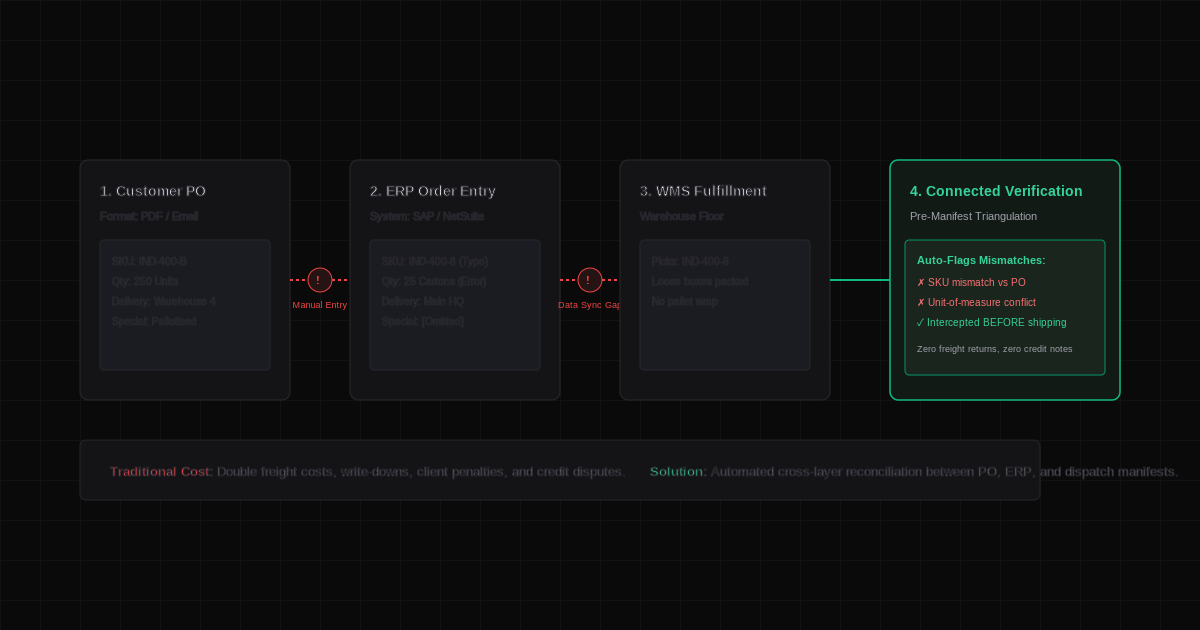
To reduce order errors systematically, organizations must trace an order along its actual operational path—from the initial customer purchase order to final dispatch—and identify the exact points where human transcription corrupts the data.
An order typically travels through four stages, crossing multiple disconnected systems:
[Customer Purchase Order] (PDF / Email / EDI)
          ↓ (Manual Data Retyping - FRACTURE POINT 1)
[ERP Sales Order Entry] (SAP / NetSuite / Odoo)
          ↓ (Batch Export / Manual Sync - FRACTURE POINT 2)
[Warehouse Management System] (Picking & Staging)
          ↓ (Manual Address / Courier Labeling - FRACTURE POINT 3)
[Dispatch & Shipping Manifest]
Fracture Point 1: The Intake Transcription
B2B customers rarely place orders through neat, standardized web forms. They email PDF purchase orders, send Excel spreadsheets, or transmit structured EDI files with unique formatting.
An internal sales administrator must open the customer's purchase order on one monitor and open the company ERP on the other. They begin retyping:
- Customer account numbers
- Stock keeping units (SKUs)
- Unit of measure (e.g., cases versus individual units)
- Delivery site addresses and gate codes
- Pricing agreements and tax exemptions
This is where transposition errors occur. An administrator accidentally types SKU IND-400-8 instead of IND-400-B. Or they enter 25 representing cartons, while the system defaults to individual pieces. The data is now corrupted at the foundation of the transaction.
Fracture Point 2: The ERP-to-Warehouse Translation
Many mid-market companies operate an ERP for finance and commercial records, but utilize a specialized warehouse management system or a third-party logistics (3PL) provider for physical operations.
If these systems are not connected by real-time bi-directional data pipelines, files are transferred via manual CSV exports or batch email handoffs. In this translation, custom fields frequently get dropped.
A critical customer instruction noted in the ERP memo field—such as "Deliver on heat-treated pallets only" or "Requires tail-lift truck"—never reaches the warehouse picking ticket. The warehouse packs standard pallets, and the delivery is rejected at the customer's receiving dock.
Fracture Point 3: Shipping Manifest and Address Overrides
The final fracture point happens at the dispatch bench. Shipping software must generate courier labels and customs declarations.
If customer shipping addresses are not synchronized programmatically, warehouse clerks copy and paste delivery details from packing lists into courier portals. Postal codes are transposed, unit numbers are truncated, and special dispatch instructions are lost. The freight carrier delivers the pallet to the customer's corporate headquarters instead of their regional distribution center.
The Solution: Pre-Dispatch Verification Over Post-Mortem Blame
Traditional management attempts to fix order errors by adding manual inspection steps: hiring a second person to double-check picking slips against packed boxes.
This approach rarely succeeds. It adds payroll overhead, slows down fulfillment speed, and still relies on the same fallible human attention. More importantly, if the picking slip itself contains a typo introduced during initial order entry, a warehouse checker will simply confirm that the wrong item was packed correctly.
Genuine error reduction requires an automated, connected verification architecture:
1. Straight-Through Order Extraction
Instead of humans manually retyping PDF purchase orders, intelligent extraction models ingest incoming customer documents directly.
The system extracts line items, quantities, SKU identifiers, and delivery instructions with high precision. It automatically cross-references the customer's internal part numbers against the company's master catalog, translating client terminology into exact internal inventory codes without human intervention.
2. Multi-System Cross-Reconciliation
Before a sales order is committed to the warehouse floor, an autonomous validation layer reconciles the order data across three reference points:
- The Original Customer PO: Does the generated sales order line match the exact quantities and descriptions requested by the client?
- Active Master Price Books & Contracts: Do the prices, discounts, and payment terms match the negotiated commercial contract?
- Real-Time Inventory State: Does the warehouse have sufficient physical stock of that exact batch, lot, or configuration to fulfill the order?
If any discrepancy or ambiguity is detected, the system flags the specific mismatch for immediate resolution before the picking process begins.
3. Automated Pre-Manifest Triangulation
At the dispatch stage, the system conducts a final automated audit before shipping manifests and courier labels are generated.
The barcode scan of the packed carton is reconciled programmatically against the original customer purchase order, bypassing any intermediate human retyping. If an operator accidentally scans a box of IND-400-8 when the original customer PO specified IND-400-B, the packing station immediately locks and alerts the supervisor.
The error is intercepted inside the building, before a single truck leaves the yard.
The Commercial Outcome: Clean Operations, Protected Margins
When a physical distribution business removes manual retyping from its order lifecycle, the results ripple across the entire organization:
- Return Freight Costs Plummet: Eliminating wrong-item dispatches directly removes the expense of emergency courier runs, reverse freight, and product repackaging.
- Credit Notes and Billing Disputes Disappear: Because invoices match the customer's purchase order and the physical delivery receipt line-for-line, accounting teams collect cash faster without protracted disputes.
- Capacity Expands Without Staffing Growth: Order intake teams shift from tedious data-entry clerks into customer service managers. The business can scale order volume by two or three times without adding back-office headcount.
- Client Retention Stabilizes: B2B customers reward flawless execution with long-term loyalty and expanded wallet share. Delivering the right goods to the right door at the right time becomes a distinct competitive advantage.
How Kalvron Eliminates Order Errors
At Kalvron, we engineer end-to-end operational systems that connect order intake, ERPs, warehouse software, and dispatch manifests into a single, unified layer.
We do not ask your team to adopt another disconnected order-management tool. Instead, we implement intelligent data bridges inside the software your company already uses. Our systems ingest messy customer purchase orders, validate lines against your master catalogs, orchestrate fulfillment data straight to your warehouse, and verify shipment fidelity before dispatch.
Stop blaming the warehouse floor for errors created in the back office. By connecting your systems and verifying data at every handoff, you protect your margins, your team's sanity, and the trust of your most valuable clients.
Find out what your business can stop doing by hand.
In 20 minutes, we map your workflow and show you where an AI OS fits. No pitch. Just the diagnosis.
Book a call