Private AI vs Public AI APIs for Business Documents: A Plain Comparison
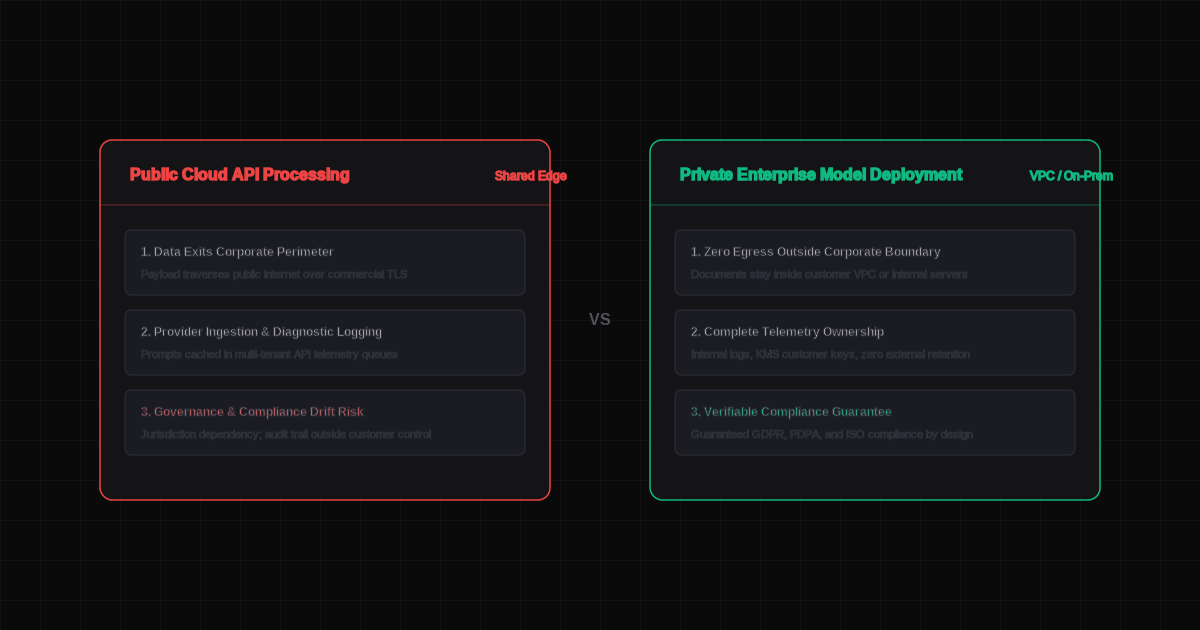
When enterprise leaders evaluate artificial intelligence for processing corporate documents, the technical discussion often centers on model benchmarks and accuracy scores.
Yet for mid-to-large businesses in Europe, Singapore, Malaysia, and the Gulf, accuracy is only half the equation. The more consequential decision is architectural: where does corporate data actually travel when an invoice, employee contract, or commercial lease is analyzed?
Every business document contains commercial secrets, personal identifiable information (PII), or proprietary pricing structures. How that information is handled depends on whether an organization uses a public cloud API or deploys a private AI environment within its own security perimeter.
Understanding the operational differences between these two models allows leadership teams to make informed choices based on regulatory compliance, risk tolerance, and long-term data sovereignty.
How Public AI APIs Process Corporate Documents
A public AI API operates as a shared, multi-tenant cloud service. When an enterprise software application needs to extract data from a supplier agreement or summarize an executive board pack, it packages the document contents into a digital payload and sends it across the public internet to an external provider's data center.
Inside the provider's infrastructure, the document is decrypted at the edge, queued in memory, and passed through the model's inference engine. Once the model generates the required extraction or summary, the output is returned to the enterprise application over an encrypted connection.
The Advantages of the Public API Model
The public model offers clear operational benefits:
- Zero Infrastructure Maintenance: The hosting provider manages GPU clusters, hardware maintenance, model updates, and scaling.
- Immediate Deployment: Engineering teams can connect an existing business application to a public API within days using standard web protocols.
- State-of-the-Art Model Access: Public APIs offer immediate access to frontier-class models with massive parameter counts, which excel at general reasoning and creative language generation.
The Tradeoffs and Risks
However, routing confidential commercial documentation through public APIs introduces distinct governance challenges:
First, data leaves the organization's perimeter. Even with transport-layer encryption, the raw payload crosses third-party networks and resides temporarily on shared multi-tenant hardware. For organizations governed by GDPR, European banking standards, Singapore's PDPA, or Gulf data residency mandates, transferring client or employee records to external multi-tenant infrastructure introduces significant compliance reviews.
Second, default logging and telemetry policies can create exposure. While enterprise API contracts frequently include zero-data-retention clauses, diagnostic logs, metadata, and error traces may still be captured in operational monitoring queues. In highly regulated sectors, verifying that no residual data exists on an external server requires third-party audits that many providers do not permit.
Third, performance stability is subject to shared resource contention. When thousands of global customers submit workloads simultaneously, public APIs can experience sudden latency spikes, throttling, or unexpected rate limits. An enterprise cannot easily negotiate prioritized throughput on shared infrastructure without committing to expensive custom tiering.
How Private AI Deployments Work
In contrast, a private AI deployment operates entirely inside the enterprise's dedicated security boundary. This can mean dedicated cloud infrastructure within a company's private Virtual Private Cloud (VPC) on an enterprise cloud host, or on-premises servers housed inside an enterprise data facility.
In this setup, open-weight or enterprise-licensed models are provisioned directly onto private GPU instances. When an internal application processes a commercial document, the request never touches the public internet.
The data flow remains entirely local:
- The document is pulled from the internal file store or ERP.
- The payload traverses an internal, isolated network.
- The private model extracts data, verifies terms, or generates reports.
- The output writes directly back into internal databases.
- All logging and telemetry remain inside the enterprise SIEM environment.
The Advantages of Private Architecture
The private deployment model delivers three decisive advantages for mid-to-large organizations:
First, absolute data sovereignty. Because no byte of customer, employee, or financial data ever leaves the company's VPC or private servers, compliance with strict data residency laws is mathematically verifiable. Regulators and enterprise auditors do not need to rely on third-party promises; the network boundary itself guarantees isolation.
Second, full control over retention and access. Encryption keys remain under internal management through Hardware Security Modules (HSMs) or enterprise Key Management Services (KMS). No external engineer, model provider, or shared tenant has physical or logical access to the memory space where documents are processed.
Third, predictable, unmetered performance. Because the compute resources are dedicated to the enterprise, processing speeds remain consistent regardless of global internet traffic. An organization running thousands of document reconciliations at month-end does not risk sudden HTTP throttling or API rate limit failures.
The Considerations of the Private Approach
Operating private AI infrastructure does require operational commitment:
- Dedicated compute resources must be provisioned and monitored.
- Models must be managed, containerized, and updated by skilled technical operators.
- Initial setup requires deliberate engineering and architectural design rather than a simple API key generation.
Comparing the Two Models Across Key Operations
To evaluate which architecture fits specific business workflows, leaders must look at how each setup behaves across practical enterprise dimensions:
| Architectural Dimension | Public Cloud API | Private Enterprise Deployment |
|---|---|---|
| Data Boundary | Exits enterprise perimeter to external multi-tenant infrastructure | Never leaves private VPC or enterprise on-premise servers |
| Data Residency | Dictated by provider region availability; multi-region routing risk | Strict, verifiable physical location inside chosen jurisdiction |
| Audit & Governance | Relies on provider SOC2 reports and contractual promises | Direct internal logging, full SIEM visibility, complete audit custody |
| Throughput & Throttling | Subject to external rate limits and shared multi-tenant load | Dedicated GPU compute with predictable throughput and SLAs |
| Operational Effort | Minimal setup; ongoing dependency on external API availability | Requires deliberate deployment and infrastructure management |
What to Ask Any Prospective AI Provider
Organizations evaluating automated document processing should not accept vague assurances about "enterprise security." To understand where an operational system actually stands, ask prospective partners these four specific questions:
1. "Where does the physical memory that processes my document reside?"
If the answer involves a shared global API endpoint, your document is processed in a multi-tenant environment. If the answer is a dedicated private instance within your company's VPC or approved local data center, data sovereignty remains intact.
2. "Who holds the encryption keys during active processing?"
All providers encrypt data in transit and at rest. But when a document is actively being analyzed by a model, it must be decrypted into compute memory. You must know whether those decryption keys are held by an external third party or controlled solely by your internal infrastructure.
3. "Are diagnostic logs, prompts, or outputs cached on external disks?"
Ask to inspect the exact data lifecycle policy. Ensure that diagnostic error tracing does not inadvertently store excerpts of financial records or employee names in third-party error monitoring tools.
4. "What happens when our processing volume surges by tenfold?"
Determine whether your operational workflow is vulnerable to public API rate limits, or whether the system is architected with queue-based, dedicated compute that guarantees job completion during operational peak periods.
The Balanced Strategy
For many mid-to-large enterprises, the ideal strategy is hybrid and workload-dependent.
Public APIs work well for low-risk, public-facing tasks: drafting generic marketing copy, brainstorming product concepts, or categorizing publicly available customer inquiries. In these scenarios, the convenience of instant access outweighs privacy considerations.
However, for core back-office operations—processing vendor invoices, parsing employment agreements, auditing medical records, and analyzing client financial portfolios—private architecture is rapidly becoming the non-negotiable standard.
At Kalvron, we engineer AI systems that fit our clients' strict compliance and data sovereignty requirements. We design and operate private, dedicated AI workflows that run inside our clients' existing enterprise environments. Data never leaves the corporate boundary, models are tuned to proprietary workflows, and operations proceed with the calm certainty that sensitive commercial assets remain strictly confidential.
Find out what your business can stop doing by hand.
In 20 minutes, we map your workflow and show you where an AI OS fits. No pitch. Just the diagnosis.
Book a call